

4 December 2025
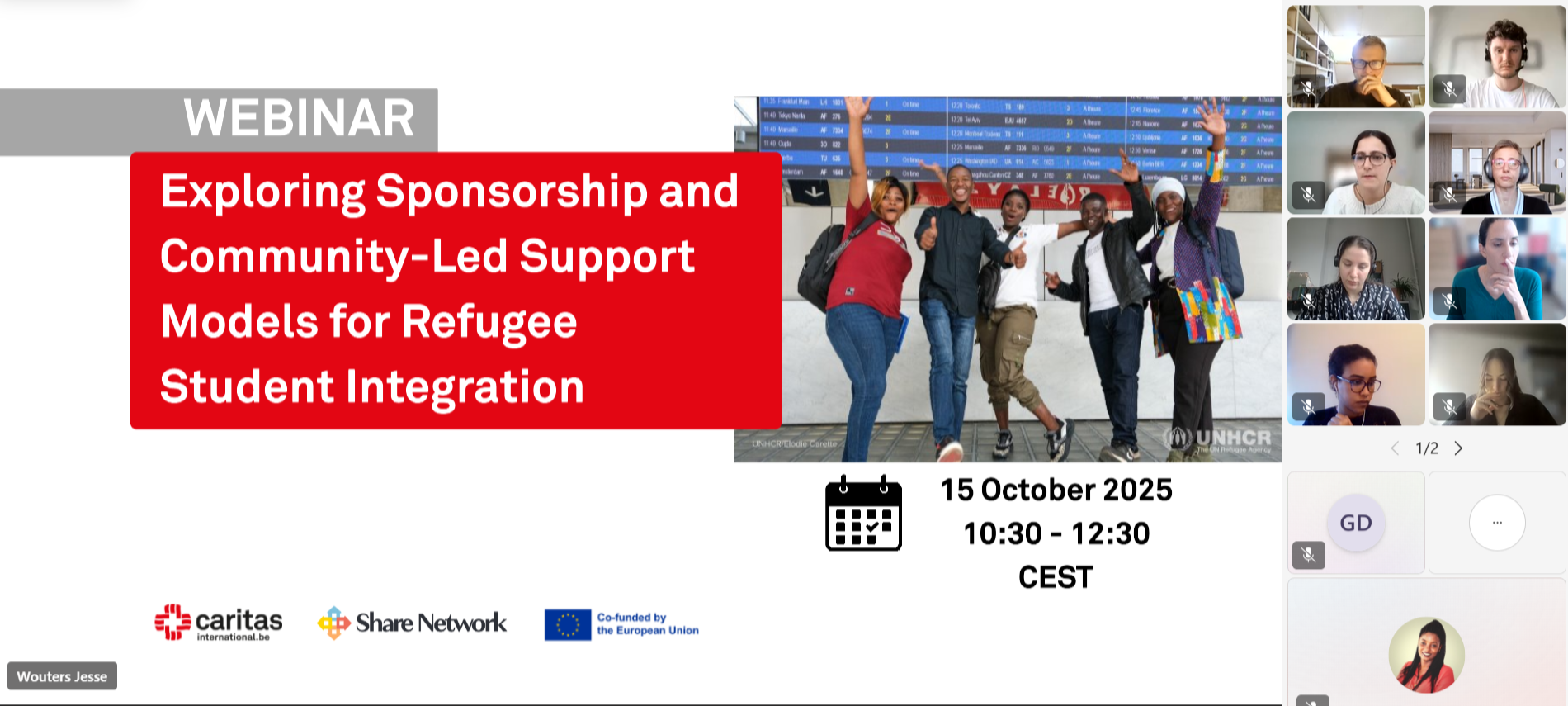
On 15 October 2025, Caritas International Belgium hosted a webinar in the framework of our Share QSN+ project to look at how community sponsorship can help refugee students access higher education. More than 100 participants joined to hear examples from Belgium, Spain, Italy, and Ireland, as well as first-hand experiences from refugee students.
The discussion showed how practical support, volunteer involvement, and cooperation between universities and civil society can make a direct difference in students’ daily lives and long-term prospects.
Support Structures in Belgium
Speakers from KU Leuven and the Centre for Transcultural Mental Health Care (CGG) explained how volunteer groups help students with administrative tasks, housing, daily questions, and emotional support. Volunteers meet regularly, receive training, and can access intervision sessions to discuss challenges that come with accompanying students who have been through displacement.
Opening Access in Spain
The University of Barcelona shared its transition-to-university programme, which combines language courses with orientation to academic and social life in Spain. The programme relies on cooperation with local authorities, UNHCR, and NGOs.
During the session, Siham Bushra Mohammed, a former student and current HERCoN advisor, described how community support helped her move from a refugee camp to completing her studies. She also stressed the need to involve refugee students in shaping policies that affect them.
Legal Pathways Through UNICORE in Italy
Representatives from the University of Tuscia presented the UNICORE programme, which enables refugee students to enter Italy legally on student visas. The programme now involves over forty universities.
Student speaker Joshua Kabelu described how initiatives like The Bridge Trust encourage refugee students to support one another and participate in local community life.
Grassroots Mobilisation in Ireland
Fáilte Cork, working with University College Cork, explained how a volunteer network raises funds and offers practical support to students. Their activities include community events, local fundraising, and collaborations with the student union and city organisations.
Common Messages
In their closing remarks, Caritas International Belgium underlined a few shared points from the session:
Community involvement helps students navigate both academic systems and daily life.
Mental health support and clear legal frameworks are important for stability.
Many programmes are beginning to give refugee students a stronger role in planning and decision-making.
Cooperation across countries and institutions is helping expand education pathways in Europe.
Find the full webinar report below.