

Written by Rachel Westerby*
19 March 2026
Continuing our celebration of the ICMC women driving our mission to serve and protect people on the move, marking this month’s International Women’s Day, we sat down with Gabriela Agatiello and Anna Coulibaly of ICMC Europe
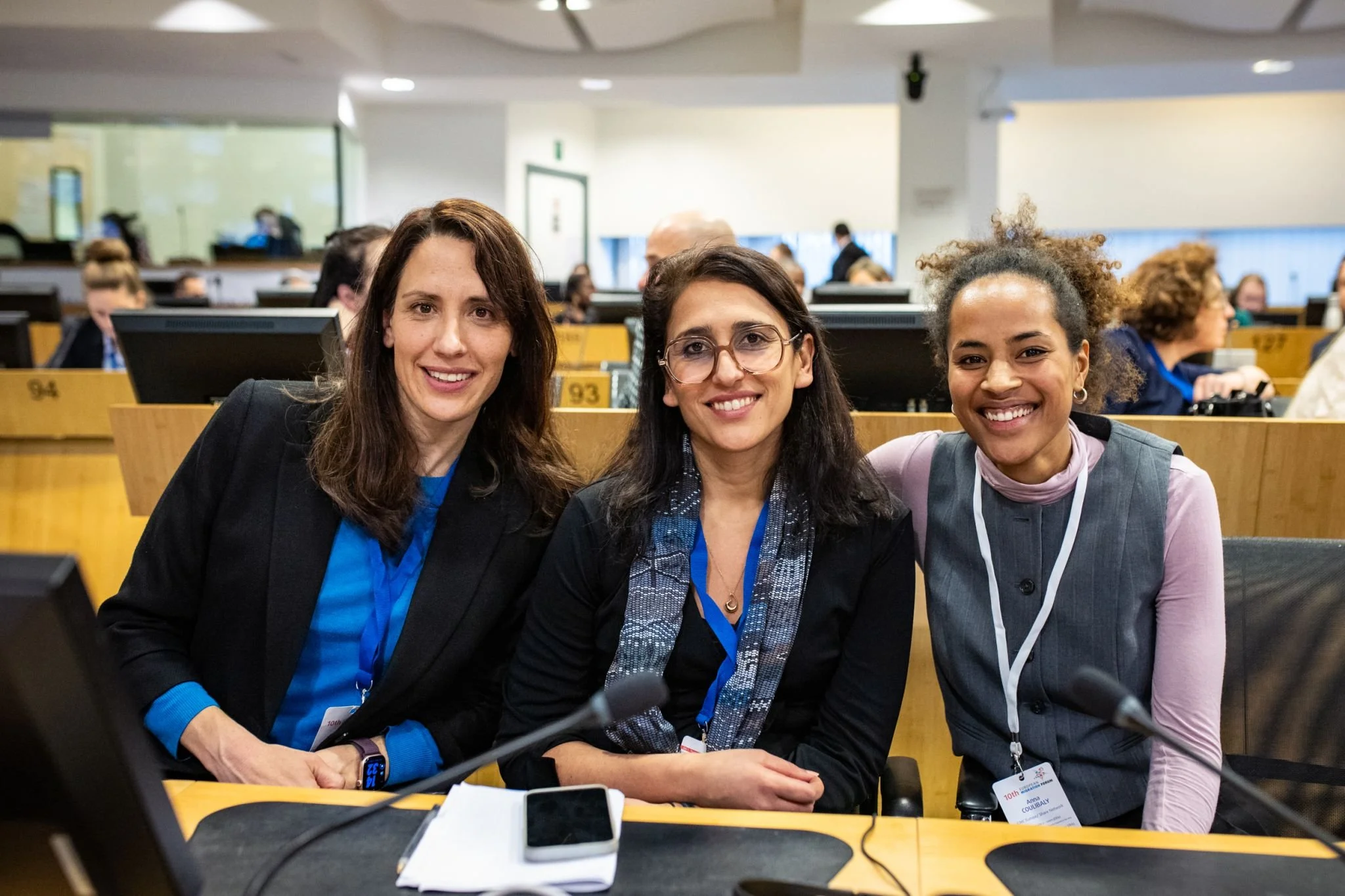
ICMC’s Gabriela Agatiello (left) & Anna Coulibaly (right) at the 2025 European Migration Forum (EMF), with Fatemeh Jailani of SINGA © European Economic & Social Research Council (EESC)/Flickr
ICMC Europe works at the center of European policymaking in Brussels, advocating alongside civil society partners for better and more inclusive migration policymaking in Europe. Through the Share Network, the ICMC Europe team supports regions, cities, towns, and rural communities to welcome refugees and migrants, offering training, capacity-building, and spaces for knowledge and best practice exchange.
To find out more about the work of ICMC Europe and the world of EU migration policy, we sat down in Brussels with Gabriela Agatiello (Head of Programmes & Policy) and Anna Coulibaly (Programme Manager).
Read part 1 of our IWD series celebrating ICMC’s women.
ICMC: Hi Gabriela and Anna, and thanks so much for your time today. Could you start by telling us something about ICMC Europe?
GA: You’re welcome! At ICMC Europe we work through the Share Network, which brings together a multitude of actors working to build an inclusive Europe, in which newcomers are received into societies where they can flourish. We focus on connecting and engaging with local actors and communities: since the network was established in 2012, we’ve engaged more than 4,500 participants from across Europe.
There’s an important European dimension to our work, which makes our grassroots activities such a valuable asset in advocacy for better policymaking and funding at EU level. As a team, we focus on making our work visible at national and EU level, and on giving a voice to our stakeholders – local communities, civil society partners, and people with lived experience – in national and European policy discussions.
ICMC: What drew you both to working with ICMC, and more generally to the field of migration, refugees, and human rights?
GA: I expect I’ll answer similarly to Anna, in that my interest comes from a combination of personal background and professional experience. Personally, migration is part of my family history, and has shaped how I understand issues of movement and belonging, and the practical effects of migration policies over time. This background made these issues familiar and meaningful, rather than purely theoretical, which I think is an important perspective.
My professional experience means I also understand the importance of community-based approaches and local leadership. That’s what drew me to the Share Network: the combination of bottom-up, community-led approaches to migration, with an EU dimension.
AC: Hello, and absolutely the same in terms of the personal and professional! I’m the daughter of a migrant, which I think gave me an intrinsic understanding of what it feels like to uproot one’s life and try to be included in a new society. I was also finishing school in Vienna, Austria, when thousands of Syrian refugees were camping at the Central Station on their way to Germany. This really opened my eyes to the plight of refugees: I focused my graduate studies on EU asylum and migration law, and started working for ICMC Europe in October 2021.
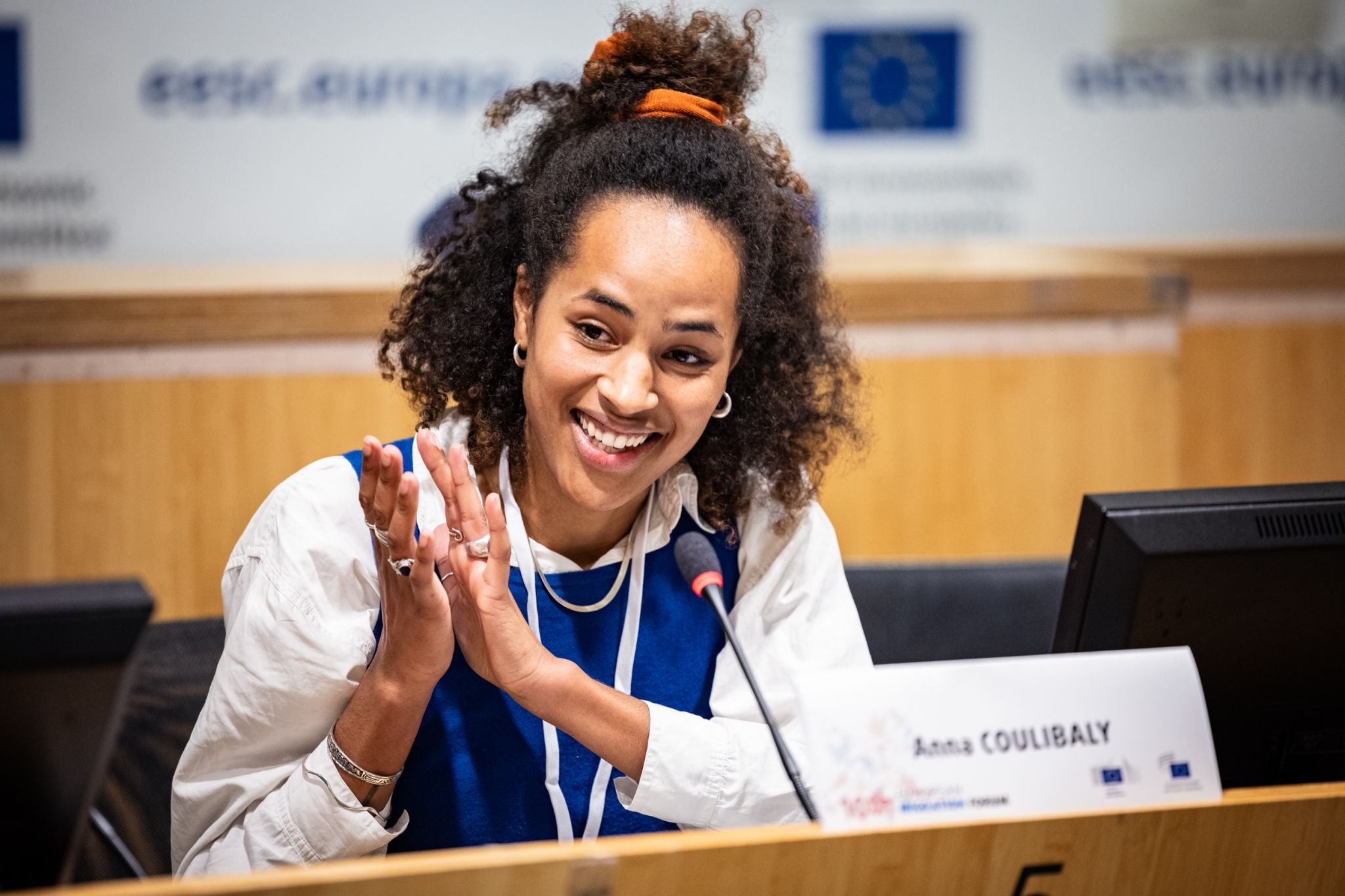
ICMC Europe’s Anna Coulibaly at the 10th meeting of the European Migration Forum © European Economic & Social Research Council (EESC)/Flickr
ICMC: What value does ICMC Europe’s focus on local communities bring to welcome, integration, and pathways to protection in the EU? What impact does your work have?
GA: I think Share goes beyond traditional and established institutional actors to bring together a broad and inclusive network of partners and stakeholders with expertise, lived experience, and grassroots knowledge. It’s a diverse and geographically wide coalition, and I think that’s what makes us unique. There’s also a unique added value through our work with rural areas and small municipalities, where capacity may be limited but openness to welcome is strong.
AC: A big value is our ability to connect local initiatives, and to welcome a multitude of actors to exchange on improving inclusion for newcomers and strengthening safe pathways. I’d also say that we’re a leading expert on community sponsorship, a program approach that enables citizen and grassroots groups to lead on refugee inclusion, with the support of local civil society organizations.
GA: I’d agree! We know that pathways are more effective when local communities are involved and supported from the outset, and I think we make a real contribution to positive and sustainable development in this area.
ICMC: Can you share some personal highlights from your work with the Share Network and ICMC Europe? What are you most proud of?
GA: I’m very proud of our work to improve the quality and sustainability of safe pathways and community-led integration approaches. We provide practical training and peer learning, and conduct advocacy at local, national, and European level, with a real impact for sponsorship and pathways.
AC: I’d agree, and add that we’ve also been influential in shaping EU policy relating to community sponsorship, as well as contributing to global UN targets for complementary pathways and resettlement. For me though, I’m most proud of our work on participation, which has really made us a frontrunner in this area of practice – I think we’ve really managed to set a model for integrating lived experience into programme design, advocacy, and policy dialogue within EU-funded projects.
GA: Overall, I think our key achievement has been developing the Share Network as a trusted expert partner at European level, particularly in the areas of community sponsorship, resettlement, and complementary pathways. We’ve sustained this work since Share was established in 2012, despite a rapidly changing European and global migration context, and we continue to make a positive impact.
* Taken from the International Catholic Migration Commission (ICMC) website.