

1. Welcome & Intro
Approaches to Refugee Sponsorship in Europe
There are currently two main types of Community Sponsorship scheme operating in Europe: Resettlement-based Sponsorship Schemes, and Humanitarian Corridors. Below we give a brief overview of how the schemes works in different countries.
This content is also available in:
Français
Italiano
Deutsch
Overview of Humanitarian Corridors
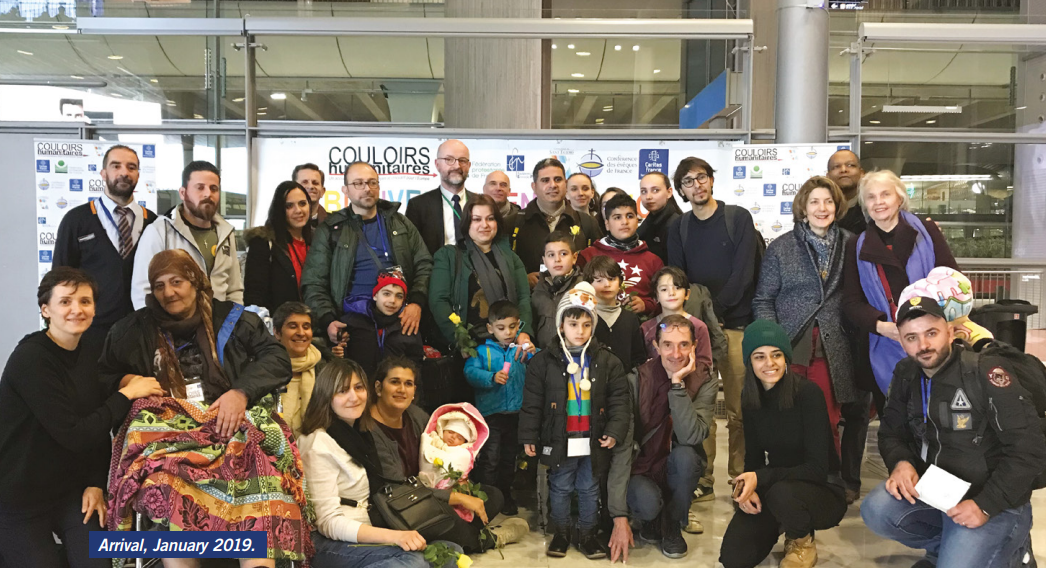
The first type of community sponsorships are the Humanitarian Corridors programmes. They have emerged in Italy, France and Belgium since 2015. Civil society actors established agreements with their respective governments to receive displaced people who are initially admitted on humanitarian visas. On arrival, they are supported with asylum applications, and socio-economic support from volunteers.
Civil Society groups (predominately faith-based) have a Memorandum of Understanding with their government. They are responsible for identifying refugees in cooperation with local organisations, the UNHCR and IOM.
Humanitarian corridor programmes offer a safe entry to vulnerable people in evident need of protection who have been identified in a first stage of assessment as prima facie refugees.
Characteristically, they follow three-stages:
NGO staff carry out exploratory visits to refugee camps and urban centres in a first country of asylum and select refugees according to vulnerability criteria.
NGOs conduct orientation and information sessions for selected candidates and secure a flight to the European country concerned.
NGOs match refugees with local volunteer groups that welcome newcomers who support beneficiaries through the phases of reception, asylum applications, and socio-economic integration.
Italy
The Italian Humanitarian Corridor (HC) programme was launched in December 2015. It offers vulnerable refugees a complementary pathway to protection (humanitarian visas) in addition to resettlement, while also providing legal access, reception and integration support.
Under the scheme, civil society organisations in collaboration with UNHCR and partners on the ground, are involved in the selection of beneficiaries, pre-departure orientation, travel arrangements, and upon arrival are responsible for providing accommodation, support in accessing language courses and general upskilling. All costs of the programme are covered by the sponsoring civil society organisations.
Beneficiaries arrive as asylum seekers, and the civil society organisations are responsible for assisting with their asylum applications post arrival.
Each of the respective partners in the programme operates with their volunteers and their own designed social and cultural integration programmes. The Italian Humanitarian Corridor programme is flexible with regards the way partners deliver integration support as well as with respect to the duration of sponsors’ responsibilities (around one year to eighteen months but can be longer or shorter as required).
Another central feature of humanitarian corridors is that they are additional to government resettlement quotas, noting that resettlement numbers in Italy have traditionally been very low.
Since the start of the programme in 2015, humanitarian corridors have welcomed approximately 10.000+ refugees to Italy. Caritas Italiana and the Federazione delle Chiese Evangeliche Italiana, leading actors in the programme, have supported and hosted approximately 3.200 of these refugees from camps in Ethiopia, Niger, Lebanon, Jordan and Turkey.
France
France established its humanitarian corridor programme in 2017 with five faith-based organisations and the French State.
Initially, 500 temporary visas were granted for asylum seekers fleeing from Syria and Iraq. Beneficiaries of the programme are identified and selected in Lebanon by NGOs and their partners according to certain criteria aimed at helping the most vulnerable, including families with young children, persons with medical issues, and LGBTQ+ individuals who are at risk.
Additional protocols were signed in 2021, allowing NGOs (FEP and Sant Egidio) to welcome a further 600 beneficiaries between them. By Autumn 2024 around 700+ refugees were hosted in France.
As is the case with the Italian Humanitarian Corridor, the programme run by FEP is organised differently than the one by Sant Egidio. Overall coordination and oversight of the programme is done by the FEP national platform, but local "Citizen Committees" (made up of 20+ volunteers per CC) are directly supported by the five regional platforms that assist in the reception and integration of the beneficiaries.
A social worker paid by FEP oversees and monitors the programme in each regional division with the support of the FEP national platform. For some refugees, additional support is needed if they are placed in an area not covered by one of the regional platforms.
Overview of Resettlement Based Sponsorship Schemes
The second type of Community Sponsorship schemes are Resettlement-based. First launched in United Kingdom (UK) in 2016, based on the Canadian-model, it has also been adopted by Spanish regional authorities from 2018, Ireland and German in 2019, Belgium since 2020 and Portugal since 2022.
Resettlement-based community sponsorship programmes enable groups of citizens to support refugees who are identified and referred by UNHCR and selected by governments within or additional to the resettlement quotas of each country.
Once refugees are selected, they are matched via NGO lead sponsors with local sponsoring groups, who are then responsible for fundraising, securing housing, and providing post-arrival support.
To date, resettlement-based community sponsorship numbers are much smaller in terms of arrivals than humanitarian corridor programmes. The number of refugees who have been welcomed through resettlement-based community sponsorship range from approximately 90 refugees welcomed through Spain’s community sponsorship programme about over 1.500 refugees in the UK.
United Kingdom
In July 2016 the first European resettlement-based sponsorship scheme was launched in the United Kingdom by the Home Office. Since the introduction of the Community Sponsorship Scheme (CSS) approximately 1.500 refugee individuals have been resettled across the UK.
Community Sponsorship groups are typically 8-20 volunteers. They must become or partner with a registered charity. They must raise a minimum of £9,000 to support the family, and find an affordable house for the family to rent (the family cannot live in the house of volunteers). Each group must prepare an application and receive approval from their Local Authority and central government. Once their application is approved, the group is matched with a refugee family who have been identified by the UNHCR, and prioritised due to their vulnerability. Groups welcome the family at the airport, and support them to rebuild their lives in the UK (helping to learn English, register with local services, find work, and become independent).
The scheme was initially set up to resettle Syrian refugees, however, it has since expanded to include refugees of all nationalities. Since 2020 refugees resettled through the CSS are additional.
When the conflict in Ukraine began, the government launched a new scheme - Homes for Ukraine - allowing any private citizen to identify Ukrainian guests, and apply to host them for a minimum of 6 months in their home. There are no requirements of this scheme, and the local authorities provide a minimal oversight, to check each host's accommodation and criminal record check. By October 2022, nearly 200,000 Ukrainians have been sponsored. Ukrainians are granted three years leave to remain.
In 2024, the Home Office launched a pilot initiative out of the UK’s commitment for Afghans in need. It aims to house 500 people per year. The UK Home Office collaborated closely with civil society organisations to design the pilot to resemble both traditional community sponsorship and Homes for Ukraine, removing all the red tape and keeping all beneficial aspects.
Germany
The New Start in a Team (NesT) programme is the German community sponsorship programme piloted in May 2019. The political responsibility for the programme lies with the Federal Minister for the Interior and the Federal Government Commissioner for Migration, Refugees, and Integration, in close collaboration with the "Civil Society Contact Point".
The NesT pilot programme aims to facilitate the resettlement of 500 refugees in addition to the resettlement quota through the mobilisation of civil society sponsorship groups composed of five+ individuals.
Financially the sponsors are responsible for providing accommodation for 2 years and supporting refugee families with practical, emotional, and integration support for at least one year.
In 2022 and 2023, the programme consolidated admission quota for NesT was 200 individuals resettled from Kenya, Jordan, Lebanon, Egypt, and Niger.
Ireland
The Community Sponsorship in Ireland (CSI) pilot programme was implemented in 2019 by the Irish Refugee Protection Programme (IRPP) in collaboration with the UNHCR, the Irish NGO sector, and a host of civic-minded and community-based actors.
Following the initial pilot phase, a mainstream programme was launched nationally by the government in 2019.
The CSI is complementary but not additional to the mainstream resettlement programmes operating in Ireland and aims to offer an alternative pathway for Syrian refugees’ integration with the help of the host communities and financial capital.
Refugees resettled under CSI have their status recognised by the UNHCR and are welcomed in Ireland as part of the IRPP (Irish Refugee Protection Programme) with a "programme refugee" status, allowing them to apply for citizenship after three years.
The first CSI refugee family arrived in Ireland in December 2018. Since then, Community Sponsorship groups have resettled over 250 refugees by autumn 2024.
Community Sponsorship groups are comprised of local volunteers supported by the National Support Organisation led by the Irish Red Cross, which closely collaborates with the Irish Refugee Council, Nasc and Doras. They are supported by the Irish Refugee Protection Programme in the Department of Children, Equality, Disability, Integration and Youth.
Volunteer groups need to provide support and secure accommodation for a refugee family for up to two years, demonstrate that they have at least 10,000 euros and are able to support refugees in accessing services such as education and employment.
Basque Country, Spain
The Basque Community sponsorship pilot programme (named Auzolana II) was launched in March 2019 as an initiative of the Basque regional government, in collaboration with central government, the UNHCR and civil society organisations.
Under the initiative, two social entities, Cáritas Euskadi and the Ignacio Ellacuría Social Foundation were selected to coordinate and monitor the programme. The entities are required to provide housing for the two-year duration of the project and financial support of 10,000 euros (financed by the Basque government). Each entity and sponsor group must also submit a settlement plan to the Basque government, detailing how they will support the sponsored families to integrate and become autonomous.
The coordination of the Auzolana II initiative is led by the Basque Government who also finances a part-time trained social worker employed by the social entities to assist the local volunteer groups in welcoming and supporting the refugee arrivals in their resettlement and integration.
A monitoring committee, which meets quarterly was also established as part of the pilot to coordinate the various actions set out in the agreement with the stakeholders concerned.
The Auzolana II experience has inspired the launch of two other regional community sponsorship pilots in Spain, including one in Valencia and the other in Navarra.
By autumn 2024, the Spanish programmes have welcomed over 100 refugees from Jordan.
Belgium
The Belgian Community Sponsorship programme was established in 2020 as a partnership between central government and Caritas International Belgium. Under the programme, refugees are referred by UNHCR to the government through Belgian’s mainstream resettlement programme, and following a medical screening and cultural orientation session, selected individuals are welcomed in Belgium and matched with a volunteer sponsor group upon arrival.
The sponsor group is responsible for providing refugees with accommodation and integration assistance for one year, including support in accessing education, employment and health services. In addition to recruiting volunteer sponsor groups, Caritas International Belgium is responsible for supporting the sponsorship groups and providing training and advice as needed.
By autumn 2024 over 90 refugees were welcomed.
Cross-country evaluations
Community sponsorship and complementary pathways in Europe have provided a humanitarian response to the global refugee crisis since 2016. By engaging local communities and leveraging their support, these approaches facilitate the integration of refugees into their new communities. In 2021, as part of the Share QSN project, the Share Network, together with its strategic partners, commissioned evaluation research to gather meaningful insight about Community Sponsorship programmes in six European countries (Belgium, France, Germany, Ireland, Italy and Spain). Qualitative data were collected from 159 individuals involved in the sponsorship programmes of 16 different localities from November 2021 to June 2022.
This series includes five thematic policy briefs from key issues that emerged from the evaluations:
Key challenges impacting the programmes at the governance level: improving sustainability in the long term
Pre-departure phase, matching between refugees and volunteers and managing expectations
The arrival phase: providing essential resources and services and structural integration
Challenges in the phase-out and end of programme
The initial impacts of the programmes in their hosting communities.